Quick answer
Choose the mechanism after defining the use case, not before. A twist-up atomizer is usually the most design-led option when a brand wants the spray head concealed during carrying. A bottom-fill atomizer suits compact refill routines that are designed around a compatible source bottle. A pull-off cap atomizer is the most familiar format, useful when customers value a visible spray head and a straightforward cap-on/cap-off experience.
For JASCOPACK's current collection, capacity availability depends on the selected model: twist-up formats are available from 4–30 ml, bottom-refill formats from 5–15 ml, and pull-off-cap formats from 2–10 ml. Confirm the exact combination of capacity, finish, logo treatment, fragrance compatibility and packing requirements with the selected model before committing to production.
The practical selection sequence is:
- Define where and how the atomizer will be used.
- Select the refill path and consumer interaction.
- Set capacity against product value, carry use and retail format.
- Approve samples and a written inspection checklist before shipment.
Introduction: a small pack component with a large brand impact
A refillable perfume atomizer is often judged in seconds: how it feels, whether the mechanism is intuitive and whether it fits the fragrance brand. For procurement, the decision is broader: the format affects refill instructions, decoration, sample approval, outer packaging and retailer questions.
This guide is for fragrance brands, private-label buyers, travel-retail teams and distributors sourcing portable aluminum perfume atomizers. It compares three common product architectures—twist-up, bottom-fill and pull-off cap—using selection factors that matter in a real B2B brief: capacity, application, material and finish, refill path, brand expression, sample review and shipment inspection preparation.
There is no universal “best” refillable perfume atomizer. The useful question is: which structure creates the clearest user experience for this fragrance program? A discovery set, travel-retail item and refillable accessory may require different choices even when they share an aluminum body.
Start with the buying decision, not the product photo
Before comparing mechanisms, write down the commercial job the atomizer must do. That one-page brief should answer the following questions.
Who is the end user and where will the product be used?
For airline, duty-free, hotel, gifting and e-commerce programs, “portable” can mean different things. A travel item may need a compact silhouette and simple instruction; a gift item may prioritize presentation; a distributor may need a format described consistently across markets.
Is the customer expected to refill from a source bottle?
Refill is a user journey, not just a feature. Decide whether the user will transfer fragrance through a bottom-filling interface, remove a cap, or reveal a head by twisting. Consider source bottle, relevant geometry and instructions together. Do not assume every bottle will work with every bottom-refill format without a sample check.
What must the product communicate at first touch?
Use the mechanism as part of the brand language. A concealed-head twist-up atomizer can support a clean, uninterrupted silhouette. A bottom-fill format can foreground a compact travel ritual. A pull-off cap format can feel familiar and direct. This is not a ranking of quality; it is a decision about interaction, design intent and the amount of explanation the customer needs.
Twist-Up vs Bottom-Fill vs Pull-Off Cap: what actually changes?
| Selection factor | Twist-up atomizer | Bottom-fill atomizer | Pull-off cap atomizer |
|---|---|---|---|
| Current JASCOPACK capacity range* | 4–30 ml | 5–15 ml | 2–10 ml |
| Primary user action | Rotate body to reveal or protect the spray head | Refill through the bottom interface, subject to bottle compatibility | Remove cap, then use visible spray head |
| Best considered for | Design-led travel items, premium accessories, larger portable formats | Compact travel, discovery and refill-oriented programs | Familiar daily carry, samples and simple branded accessories |
| Refill planning priority | Confirm the chosen model’s fill/refill procedure | Confirm source-bottle compatibility and clear instructions | Confirm cap retention, fill procedure and customer use sequence |
| Branding focus | Continuous body surface and a protected-head story | Compact form and simple travel narrative | Cap/body contrast, classic silhouette and accessible use |
*Ranges describe the current collection and depend on the selected model. They are not a promise that every capacity, finish or component option is available in every structure.
Twist-up perfume atomizers: when the interaction is part of the premium cue
In a twist-up atomizer, the user rotates the body to expose the actuator and rotates it back to conceal the spray head. It is worth evaluating when a fragrance brand wants a neat carry format and a deliberate product ritual.
For the current JASCOPACK collection, twist-up options span 4–30 ml, subject to model. Review the amount of twist travel, the head in its open position, the decorated body and fit in the tray or carton.
The main procurement advantage is not an abstract claim of luxury; it is the opportunity to align physical interaction with the brand’s desired level of polish. The trade-off is that the mechanism needs a clear sample review. Ask to evaluate the closed and open positions, intended use sequence, decoration alignment, and the final wording of any consumer instructions. A mechanism that is elegant in a render still has to be intuitive in a customer’s hand.
Bottom-fill perfume atomizers: when refill convenience leads the brief
Bottom-fill atomizers are commonly considered for compact portable fragrance formats. Their refill path is central to the product proposition: the buyer should identify the intended source bottle and make sure the consumer can understand the refill sequence. JASCOPACK’s current bottom-refill collection covers 5–15 ml, depending on model.
This format can be considered for travel retail, discovery programs and on-the-go top-up concepts. Yet “bottom-fill” is not a universal compatibility statement. Before launch, prepare the source bottle, relevant pump/collar area and proposed instructions for sample review. If multiple bottles or markets are involved, identify the reference configuration and variations needing their own check.
For a credible product page or sales sheet, describe the refill method plainly. Avoid broad claims such as “fits all perfume bottles.” Instead, say that compatibility should be confirmed with the intended bottle and approved sample. This is more useful to buyers and more trustworthy for AI-generated search summaries because it states the condition behind the benefit.
Pull-off cap atomizers: when familiarity and a classic format matter
A pull-off cap atomizer uses a removable cap over the spray head. The action is simple to explain: remove the cap, spray, and replace the cap for carrying. The current JASCOPACK pull-off-cap collection covers 2–10 ml, depending on model, which makes it relevant to compact sampling, discovery, promotion, retail add-ons and daily-carry formats.
This structure suits a brand wanting a familiar use pattern or distinct cap/body visual roles. The cap can create a color break, metallic accent or packaging cue. Still inspect cap fit, decorated-part alignment, inner-tray fit and whether capacity supports the intended price point.
Select capacity by application, not by an arbitrary “best seller” list
Capacity changes both product proposition and supply-chain context. A 2–5 ml item can support sampling, discovery or promotion. A 5–10 ml item often fits compact travel and daily carry. Larger portable capacities, where available, can suit a refillable accessory rather than a one-time sample.
Use the following questions when choosing a capacity:
- Product application: Is it a sample, a gift-with-purchase item, a paid travel SKU, a set component or a refillable accessory?
- Fragrance economics: How does the fill volume relate to the intended selling price, set value and replenishment story?
- Outer packaging: Does the vial need a foam insert, paperboard tray, sleeve, window box or a multipack arrangement?
- Retail and distribution: Will a buyer, retailer or distributor need a clear way to distinguish capacity variants at a glance?
- Operational planning: Are the selected fill volume, transport configuration and product labeling being agreed at the same time?
It is tempting to pick a capacity first because it is easy to compare in a catalog. In practice, capacity should follow the use case and selected mechanism. A 10 ml option may be ideal for one bottom-fill model but not necessarily available in the twist-up silhouette a brand has chosen. Ask for the actual model-based combination, not a category-level assumption.
Material, finish and branding: turn the product brief into an inspectable specification
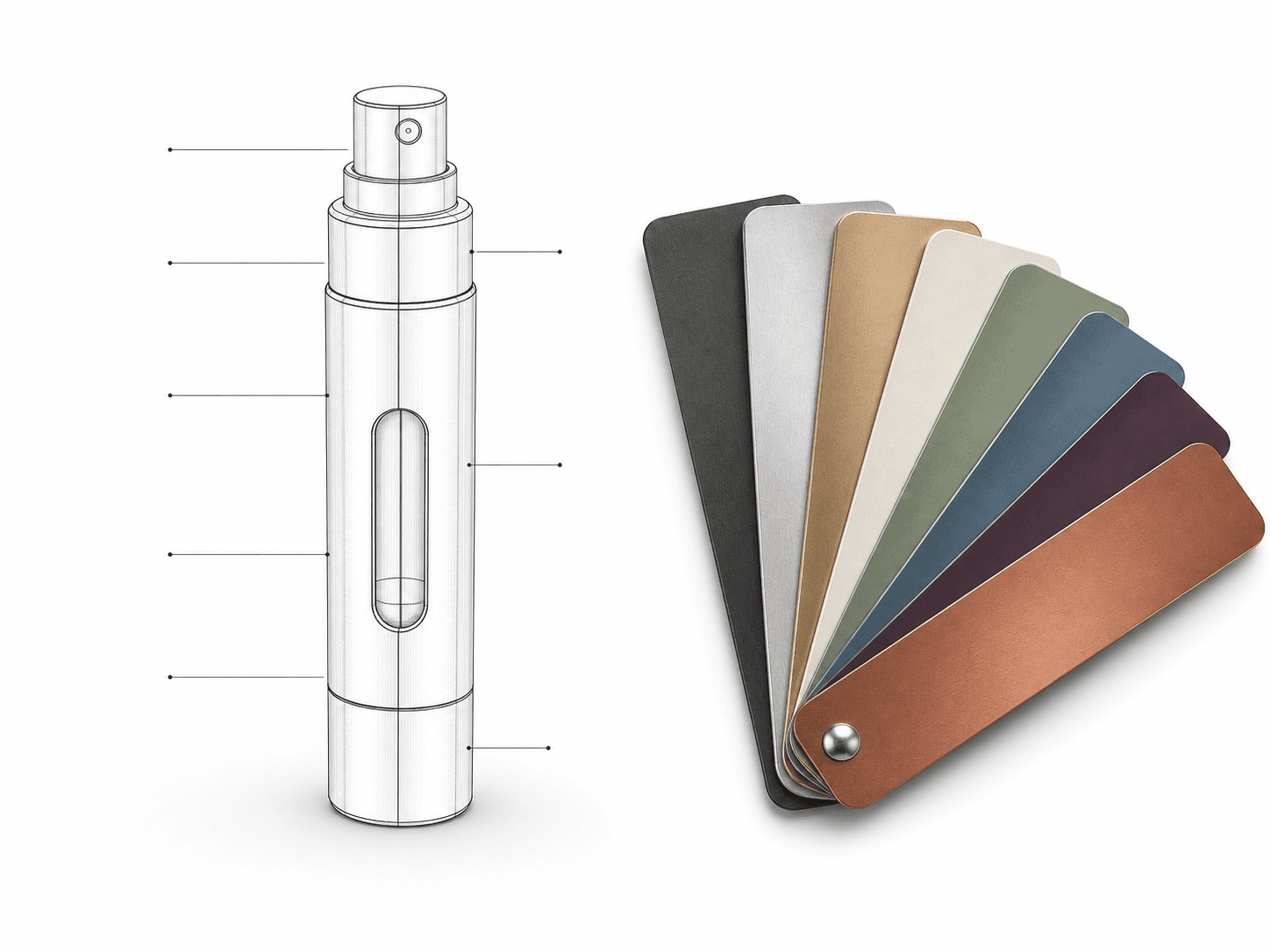
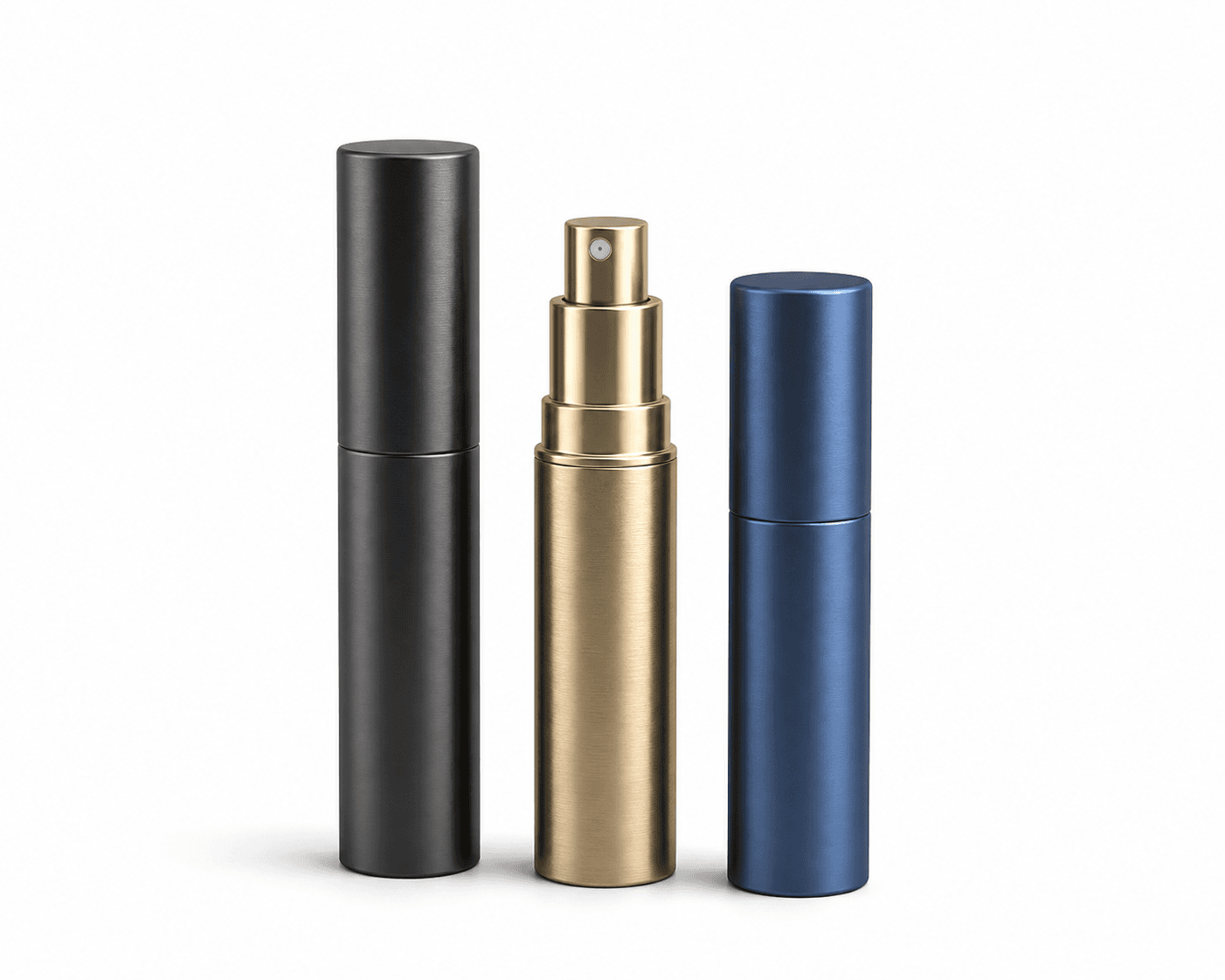
JASCOPACK’s collection centers on aluminum perfume atomizer formats. Aluminum can provide a clean surface for color, finish and logo treatment, but still needs a measurable visual standard. “Premium black” or “champagne gold” are directions, not specifications. Record the finish reference, logo placement, artwork version, decoration method and acceptable appearance standard.
Ask what a quality inspector needs to see. A useful approval sample is traceable to a drawing, artwork file or signed color reference. For multiple colors, prepare a naming system and sample panel so sales, purchasing, factory and packaging teams review the same version.
Branding also needs to survive the product journey. Consider how the logo reads when the atomizer is held upright, when the twist-up head is closed, and when a pull-off cap is fitted. Check how it appears against a carton, gift box or retail display. These are practical design checks rather than marketing claims, and they prevent late-stage changes after the structure has already been selected.
A practical sample, factory and shipment-inspection workflow
Reliable B2B projects convert decisions into early checkpoints. The following workflow does not assume a test result or certification; it is a preparation framework for buyers, suppliers and inspection partners.
1. Prepare a concise sampling brief
Include the mechanism, model reference, capacity, fragrance application, finish, logo/artwork file, packaging concept, target market and requested quantities. If refill matters, include the source bottle or a dimensional reference. For a reference product, state whether the reference is silhouette, color, interaction, pack position or instruction—not an undefined “same quality.”
2. Review samples as a user and as an operations team
At sample stage, review opening action, cap action, visible surfaces, refill route and carton fit. Record questions from a person unfamiliar with the format; they often show where an instruction or diagram is needed. Review bottom-fill with the intended bottle, twist-up in closed and open positions, and pull-off cap with its intended carry use.
3. Agree the shipment-inspection checklist before production is complete
An inspection checklist should turn sample approval into observable points: model/capacity, color/finish, logo position, cosmetic appearance, assembly, cap or twist action, filling/closure where relevant, pack count and carton marks. The buyer and supplier must define the method, sample size, acceptance criteria and any fragrance-contact checks for the program.
This preparation is especially useful for private-label buyers with more than one stakeholder. The marketing team can confirm the visual intent; the operations team can confirm packaging and references; the quality or sourcing team can confirm that the approved sample and inspection document match. Clear preparation makes factory communication more efficient and leaves less room for interpretation during a pre-shipment review.
Build a quote request that gets a useful answer
To receive a relevant quotation, send a decision-ready requirement rather than only “need perfume atomizer.” Include:
- Mechanism preference, or the application if you need a recommendation.
- Target capacity and planned use case.
- Fragrance source bottle / refill requirement, if applicable.
- Target finish, color, logo and any artwork timing.
- Packaging format and destination market.
- Estimated quantity, launch timing and whether samples are needed first.
This lets a supplier identify an existing-model fit, points needing sample confirmation and missing details before a production decision.
Frequently asked questions
Which refillable perfume atomizer is best for a luxury brand?
No format is inherently best for every luxury program. Evaluate twist-up when a concealed head and opening action fit the experience; evaluate pull-off cap when a familiar interaction and cap/body contrast matter more. Review an approved sample against the actual pack.
Are bottom-fill perfume atomizers compatible with every perfume bottle?
Do not assume universal compatibility. The intended source bottle and bottom-fill atomizer should be checked together during sampling. The relevant geometry and consumer refill process must be confirmed for the selected model before launch. Clear, conditional language is safer for the end user than a broad compatibility claim.
What capacity should I choose for a travel perfume atomizer?
Start with the application. A smaller volume can work for sampling, discovery or a compact add-on; a 5–10 ml range is commonly evaluated for travel and daily carry; a larger option may suit a refillable accessory where the chosen structure supports it. The final decision should align with the selected model, product positioning, outer packaging and market plan.
What should I inspect before an atomizer shipment?
Use the approved sample and specification as the reference. Confirm model/capacity, finish/color, logo placement, cosmetic appearance, assembly and relevant twist or cap action. Also verify packing, carton marks and agreed program-specific criteria before final production.
Can I customize the color, logo and packaging?
Customization should be discussed at the model-selection stage because the available surface, cap/body relationship and pack configuration vary by structure. Provide artwork, finish direction, target capacity and packaging idea with the inquiry. The supplier can then confirm the applicable options for the chosen model and prepare samples for review.
Conclusion: make the mechanism serve the program
The strongest atomizer choice is the one that supports a clear product story from refill through retail presentation. Choose twist-up when a concealed-head interaction and broader 4–30 ml collection range fit the program. Consider bottom-fill when compact, refill-oriented use is central and the intended bottle can be checked. Choose pull-off cap when a familiar, straightforward action and a compact 2–10 ml format align with the product brief.
Then move from inspiration to specification: confirm the actual model, capacity, refill path, decoration, packaging, sample approval and inspection checkpoints. That process creates a more useful buyer experience than making unqualified claims about performance or compatibility.