Quick answer
Perfume atomizers usually leak because one interface in the dispensing system is not controlled for the actual product and its journey: the pump and seal stack, refill valve, vial-to-body fit, liquid compatibility, assembly condition, or shipping orientation. A reliable B2B response is not to promise that a portable pack is “leak-proof.” It is to define the liquid, component configuration, use case, validation methods, and product-specific acceptance criteria before production.
For fragrance brands and packaging buyers, the practical goal is to detect avoidable risk early. Review the design against the intended formula, approve representative samples, agree a written quality plan, and repeat the relevant checks during production and pre-shipment sampling. The guide below explains what each check can tell you—and what it cannot.
Introduction: leakage is a system problem, not a single-part problem
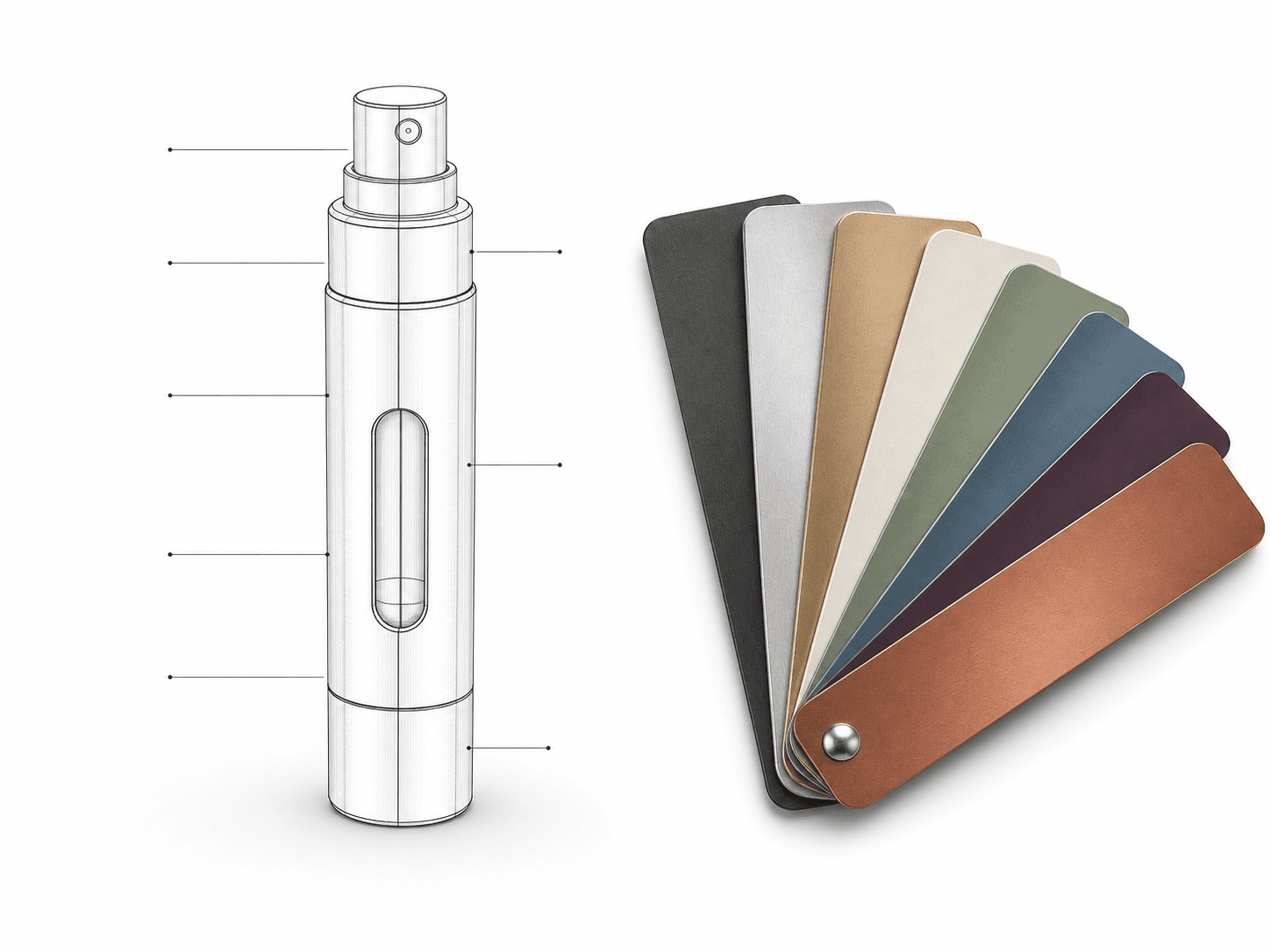
Small refillable perfume atomizers combine a vial, pump, actuator, cap or twist-up mechanism, seals, refill path, decorative body, and retail or transport packaging. A customer may experience “a leak” as perfume around the cap, a damp carton, a low fill level, or a scent appearing in a sealed pouch. The visible symptom matters, but it does not by itself identify the root cause.
That distinction is important in supplier qualification. A pack that sprays correctly at a desk can still be stressed by the selected fragrance, repeated refilling, temperature changes, vibration, side storage, or compression in a consolidated shipment. Conversely, a trace of liquid left after filling can look like leakage even when the fluid path is intact. Procurement and quality teams get a more useful result when they ask for a failure description, a sample configuration, and a test plan rather than a generic assurance.
This article is written for teams evaluating portable fragrance packaging for private-label, travel retail, gift-set, sampling, and e-commerce applications. If you are still deciding between refillable formats, see the related guide on choosing a refillable perfume atomizer.
What counts as leakage during a packaging review?
Before selecting a test, define the observation and the exposure. “Leakage” may mean an active liquid path from the reservoir, a seep at a seal, a spray residue created during actuation, or an exterior contamination issue created during filling. These need different investigations.
Separate an active leak from handling residue
In a controlled review, clean and dry the exterior first, record the sample identification, then observe the pack after the agreed handling or storage condition. If liquid returns at a consistent location, the location is useful evidence: around the pump crimp or neck, refill valve, cap interface, bottom opening, or vial/body joint. If the liquid is only present immediately after a fill or spray operation, the filling and wiping method may need review as well as the component.
Document the configuration, not just the appearance
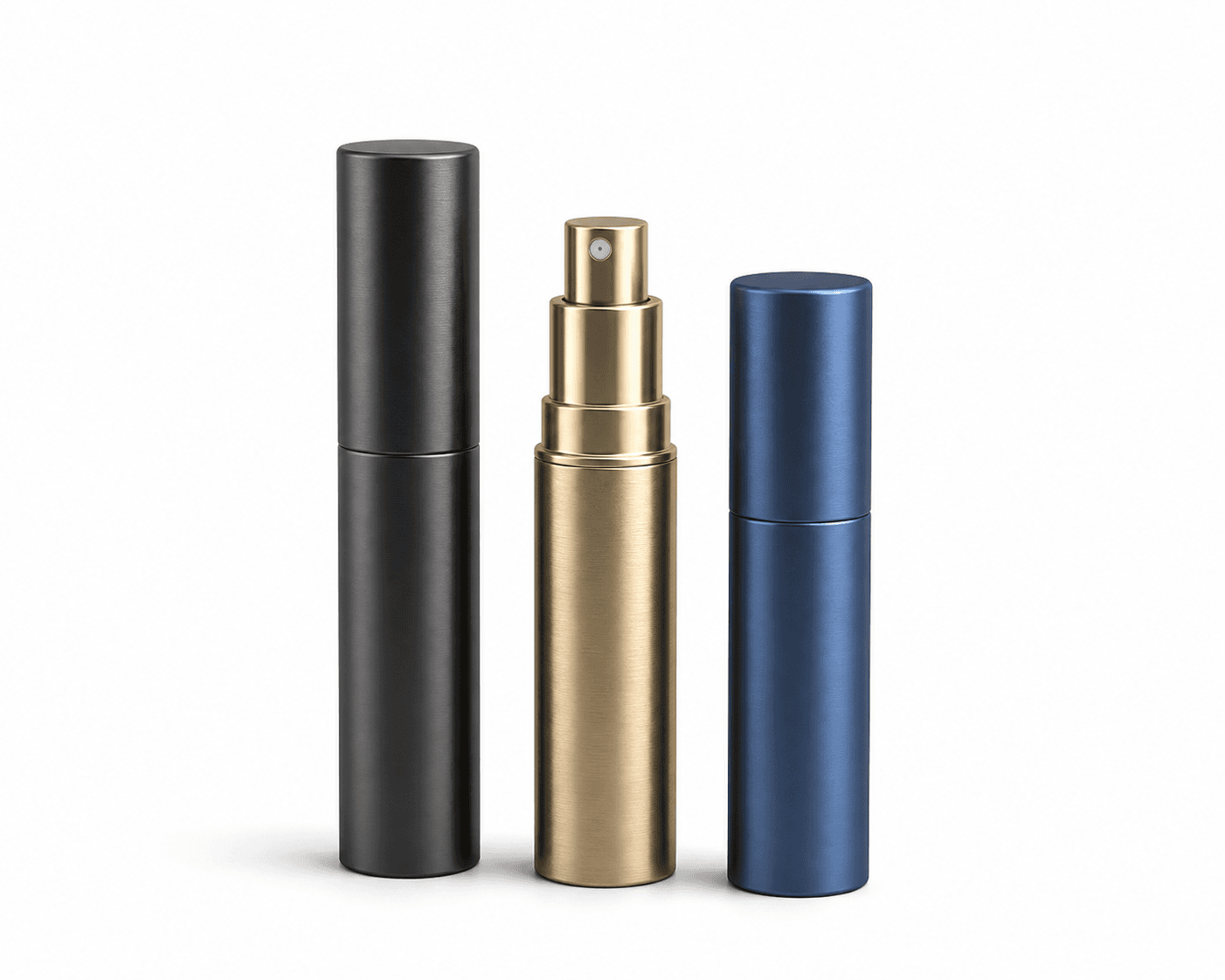
The same outer aluminum body can behave differently with a different glass vial, pump, gasket, collar, cap, actuator, or fragrance formula. A useful record names the component versions, filling method, nominal fill target, liquid type, sample condition, storage orientation, and test sequence. This turns a vague quality complaint into a repeatable review.
Six common reasons perfume atomizers leak
1. Pump and seal-stack mismatch
The pump, gasket or sealing element, collar, and vial neck work as a stack. A dimension or assembly variation at one interface can reduce the intended seal even when each individual part looks acceptable. A displaced gasket, incomplete crimp, inconsistent seating, damaged pump stem, or actuator that does not return cleanly can all create a fluid path.
For buyers, this is why a spray-function check alone is incomplete. The test should observe both dispensing performance and the relevant sealing area after actuation and after the agreed storage condition. During sample approval, request clear identification of the approved pump and vial combination so later substitutions are not treated as equivalent without review.
2. Refill-valve or bottom-fill interface issues
Bottom-refill and other refillable designs introduce a second functional interface. If the refill valve is contaminated, not centered, damaged, or paired with an incompatible source nozzle, it may not close as intended after filling. Repeated or forceful refill use can also differ from the controlled condition used during development.
The buyer should therefore describe how end users will refill the product: from a fragrance bottle, a filling fixture, or another transfer method. A validation method can then include the expected refill action, exterior cleaning, and post-refill observation. It is not enough to test only a new, unfilled atomizer when the product will be sold as a refillable item.
3. Fragrance formula and material compatibility
Perfume formulas vary in alcohol content, oils, colorants, and fragrance compounds. Materials that appear satisfactory with one liquid may need separate review with another. Compatibility is not established by appearance alone, and it should not be assumed from a generic material description.
For a buyer, the practical request is a representative product-liquid sample or a mutually agreed surrogate where the final formula is confidential or unavailable. The approved quality plan should state what liquid was used for validation, what exposure condition was used, and who approves changes to the formula, pump, sealing material, or vial. Do not claim broad formula compatibility unless it has been specifically reviewed for the configured product.
4. Vial-to-body fit and internal movement
Decorative bodies protect and position the reservoir, but they also add assembly interfaces. A vial that is not seated or retained consistently can shift under handling. That movement may load the pump, valve, or connection points and can make a problem intermittent. A tight-looking exterior is not proof that the internal fit is controlled.
Dimensional inspection and assembly-fit verification are useful here. During development, examine the selected vial and body together, including the cap or twist mechanism. During production, sample checks should confirm the approved combination rather than relying solely on visual similarity. If the project uses several colors, finishes, or decorative components, evaluate whether any process step could affect fit or handling.
5. Damaged, contaminated, or incorrectly assembled components
Small defects can matter at sealing interfaces. Nicks, deformation, particles, cross-threading where threaded parts are used, incomplete closure, or a component introduced from a different revision can create a failure that is not obvious in a product photograph. Damage may also occur after assembly if components are not protected during packing.
Incoming material review, visual inspection, and controlled assembly work together in this case. A meaningful report should identify the inspection point and sample, not simply state “passed.” Buyers can ask the supplier how component revisions are controlled, how nonconforming material is separated, and how the approved sample is referenced on the production floor.
6. Storage orientation and shipment stress
An atomizer can encounter side storage, repeated movement, carton compression, and temperature variation between factory, forwarder, warehouse, and destination. These conditions do not create every leak, but they can expose a marginal seal or an insufficiently protected assembly. A carton that arrives damp does not automatically prove a product design defect; it calls for a traceable review of product condition, inner protection, pack orientation, and transport evidence.
Shipment inspection should therefore include the finished product in its intended protective packaging, not only loose units. It should also record the orientation and the condition of the outer and inner packs when samples are opened.
From a test method to an approved quality plan
A test method is a way to expose or observe risk. An acceptance criterion is the agreed decision rule for the selected product. They are related, but they are not interchangeable.
For example, a storage-orientation check can reveal whether liquid appears around an interface after a defined condition. The acceptance criterion must still be agreed for that specific product: which sample configuration is tested, how it is cleaned before observation, what constitutes unacceptable leakage, how many units are sampled, and what disposition follows a failure. The same applies to spray, refill, fit, and shipment checks. Product-specific acceptance criteria should be written and approved by the buyer and supplier; they should not be copied from an unrelated atomizer program.
A practical inspection matrix
| Checkpoint | What the method helps evaluate | What buyers should define in the approved plan |
|---|---|---|
| Visual and component review | Damage, contamination, finish defects, correct parts and identification | Approved sample/reference, component revisions, cosmetic limits, handling of nonconforming parts |
| Dimensional review | Critical interfaces such as vial, collar, body and closure fit | Dimensions/tolerances to review, measuring method, sampling approach and records |
| Spray and seal function check | Dispensing consistency and visible liquid around relevant interfaces | Fill condition, actuation sequence, observation points, cleaning procedure and acceptance decision |
| Refill-function check | Refill path performance for the intended use | Compatible source/nozzle or fixture, refill sequence, post-refill observation and user-use assumptions |
| Assembly and fit verification | Vial retention, cap/twist movement, internal movement and component pairing | Approved component stack, assembly reference, fit limits and escalation for substitutions |
| Pre-shipment sampling review | Whether finished, packed goods match the approved project specification | Sampling plan, packing configuration, review checklist, photos/records and release authority |
JASCOPACK currently presents its quality process as incoming material review, dimensional inspection, spray and seal function check, appearance and finish inspection, assembly and fit verification, and pre-shipment sampling review. These are useful capability and process checkpoints to discuss with a buyer. They are not, by themselves, a guarantee of a particular result for every model, formula, shipment route, or project. The approved project specification and agreed records determine what is actually checked.
How procurement teams should prepare factory testing
Factory testing is more effective when it starts before the purchase order rather than only after a complaint. The following sequence gives product, sourcing, and quality teams a common frame of reference.
1. Freeze the intended configuration at sample approval
Confirm the model, capacity, vial, pump, refill mechanism, cap or twist-up component, finish, logo treatment, and retail or transport packaging. Record the sample identification and any approved exceptions. If a substitute part, finish process, or liquid is proposed later, route it through change review instead of assuming the original validation still applies.
2. Build the test around the real application
State whether the unit will be factory-filled, filled by a brand, sold empty for consumer refill, packed in a gift set, or sent through parcel networks. These choices affect which interfaces and conditions matter. A travel-retail sample, a direct-to-consumer parcel, and an in-store gift set may need different packaging and inspection emphasis even when the atomizer body is identical.
3. Ask for observable records
The most useful production documentation is specific: sample identifiers, component versions, photos of the setup and condition, the test sequence, observations, and the release decision. Avoid accepting a generic statement that a product was “fully tested” without knowing what was tested against which agreed requirement.
4. Treat pre-shipment inspection as a release gate
Pre-shipment sampling is an opportunity to compare finished, packed goods with the approved specification. Check labeling, appearance, component pairing, functional samples, inner protection, carton condition, and packing orientation where relevant. If an independent inspection is part of the program, align its checklist with the supplier’s agreed quality plan so the two teams are evaluating the same product definition.
RFQ checklist: information that makes leakage review more useful
Add the following to an inquiry or quality brief:
- Intended atomizer model, capacity, and preferred refill mechanism
- Whether the product will be factory-filled, brand-filled, or consumer-refilled
- Formula status: final fragrance, representative liquid, or agreed surrogate
- Target market and sales channel, including travel, gift set, retail, or e-commerce use
- Required cap, twist-up, or protective feature and any user-opening expectation
- Decorated-body, logo, color, and packaging requirements that could affect assembly or handling
- Expected shipment configuration, destination, and any special orientation or protection requirement
- Sample quantity and the approval owner for design, function, and appearance
- Requested validation methods, documentation, and pre-shipment inspection scope
- Product-specific acceptance criteria and the escalation route if a sample does not meet them
This information also helps a supplier distinguish a design question from a process question. It reduces the risk of receiving a quotation based on a generic stock configuration when your actual project depends on a different liquid, body treatment, or packing method.
FAQ: perfume atomizer leakage and quality control
Can a perfume atomizer be described as completely leak-proof?
Avoid absolute claims for a portable, refillable package. Performance depends on the approved component configuration, liquid, use pattern, assembly, and shipment exposure. A better supplier conversation defines the intended use and agreed validation instead of relying on a blanket promise.
Is a spray test enough to qualify an atomizer?
No. A spray check helps evaluate dispensing, but it does not replace refill-function, seal observation, assembly-fit, dimensional, packaging, and pre-shipment checks where those are relevant to the project. Select methods based on the real product risk.
Why did a unit leak only after shipment?
Transport may reveal a marginal assembly, a damaged component, an insufficient protective pack, or an issue related to storage orientation. Preserve the carton, protective materials, sample identification, and photos if possible. Those details make root-cause review more reliable than a report of “shipping damage” alone.
Should the final fragrance be used for validation?
Where practical, use the final fragrance or a mutually agreed representative liquid. If confidentiality prevents that, document the surrogate and the limitations of the review. A material or formula change should trigger a decision on whether the relevant validation needs to be repeated.
What should a pre-shipment inspection report include?
At minimum, it should identify the order or lot, the finished configuration reviewed, sampling approach, packing configuration, observations, photos or records, and the release decision against the approved specification. The exact fields and acceptance criteria should be agreed before the inspection.
Conclusion: make the evidence fit the application
Leakage prevention starts with a clear product definition and ends with a release decision supported by the right evidence. The most valuable B2B quality plan does not use the word “leak-proof”; it identifies the relevant interfaces, verifies the approved component stack, uses representative handling conditions, and documents the agreed acceptance criteria.